
NIGHTS & SLEEP
My senior dog won’t sleep. What exactly is happening?
Sleep changes are common concerns among people caring for older dogs, but “my senior dog won’t sleep” can describe several very different problems. This guide will help you identify the nighttime pattern you are seeing, track it more clearly, evaluate whether anything you try is actually helping, and prepare useful observations for your veterinarian.
Nighttime problems can feel like one big issue: your dog is awake, you are awake, and something clearly is not working.
But “won’t sleep” can describe several different patterns. A dog who cannot settle at bedtime is experiencing something different from a dog who falls asleep easily but wakes every two hours.
The first step is to identify which part of the night is changing.
New, sudden, painful, severe, or rapidly worsening nighttime changes should be discussed with your veterinarian rather than assumed to be a normal part of aging.
START WITH THE PATTERN
Which nighttime problem are you actually seeing?
When someone says, “My senior dog won’t sleep,” that can mean very different things.
Before trying to fix the night, get more specific about which part of the night is breaking down.
Getting more specific helps you decide what to watch, what to track, and what information may be useful to your veterinarian.
Takes a long time to settle
Your dog seems tired but cannot quite get comfortable. They may repeatedly get up, change locations, pant, wander, circle, or seek reassurance before finally resting.
Falls asleep but wakes repeatedly
Your dog settles normally at bedtime, but sleep doesn’t last. They wake several times during the night, even if they eventually settle again.
Wakes and cannot settle again
The first part of the night may go well. Then your dog wakes and becomes restless, vocal, anxious, or unable to return to sleep.
Paces or wanders between sleep periods
Instead of quietly waking and resettling, your dog moves from room to room, circles, changes sleeping locations, or seems unable to stop moving.
Seems calmer but remains awake
A change may reduce pacing, panting, or vocalizing without actually restoring sleep.
Calmer can be an improvement. But it’s not automatically the same thing as sleeping better.
Sleeps longer but seems unusually groggy the next day
More hours asleep may look like a success until you notice your dog is much less alert, less steady, less interactive, or unusually tired the following morning.
The better question is not simply, “Did my dog sleep?”
Ask: What part of the night improved—and what happened the next morning?
MAKE THE NIGHT MEASURABLE
Stop judging the whole night as “good” or “bad.”
A night can contain several different outcomes. That matters because one part may improve while another stays exactly the same.
BEDTIME
How long did it take your dog to settle?
Did they lie down fairly easily, or was there pacing, panting, circling, repeated repositioning, or difficulty becoming comfortable?
FIRST SLEEP STRETCH
How long before the first waking?
Was it 30 minutes, two hours, or most of the night?
OVERNIGHT
How many times did your dog wake?
Try to count the awakenings rather than relying on an overall impression that the night was better or worse.
AFTER EACH WAKING
How quickly did your dog settle again?
Did they lie back down within a few minutes—or stay awake, pace, vocalize, or wander for much longer?
EARLY MORNING
Did waking begin unusually early?
A dog who sleeps reasonably well until 3:00 a.m. has a different pattern from one who is restless from bedtime onward.
NEXT DAY
How did your dog seem in the morning?
Alert? Comfortable? Engaged? Tired? Unsteady? Unusually sleepy?
Nighttime changes should also be judged by what happens the next day.
One part of the night can improve while another does not.
Your dog may fall asleep faster but still wake four times. Or your dog may sleep two hours longer but seem much more groggy the next morning.
That is why “it worked” is often too vague.
LOOK CLOSER
What does your dog actually do when awake?
The fact that your dog is awake tells you only part of the story. What happens during that waking can make the pattern much clearer.
These behaviors are not diagnoses. They are observations.
A MORE USEFUL DESCRIPTION
Instead of:
“He was restless all night.”
Try:
“He woke four times, paced for about 15 minutes after each waking, and asked to go outside twice.”
DURING THE WAKING
What happens during the waking?
Specific observations make it easier to compare nights and explain the pattern to your veterinarian.
LOOK FOR CONTEXT
Is there a repeatable pattern around each waking?
Once you know what your dog does after waking, look at what seems to happen around it. You are not trying to prove what caused the waking. You are simply looking for context that repeats.
WHEN IT HAPPENS
WHAT HAPPENS AROUND IT
You don’t need to explain the pattern yourself.
Your job is to make the pattern visible enough that you can describe it. If the same sequence happens night after night, that is useful information to bring to your veterinarian.
Once you can see what happens around the waking, the next question is whether the daytime pattern is changing too.
THE NIGHT DOESN’T EXIST IN ISOLATION
What’s happening during the other 16 hours?
It’s easy to focus completely on nighttime when everyone is exhausted. But changes during the day can help complete the picture.
Look for changes that appeared around the same time as the nighttime problem. You do not have to decide whether they are connected—just record what is different from your dog’s usual pattern.
LOOK FOR THE CLUSTER
Several small changes happening together may be easier to miss when you look at each one separately.
DURING THE DAY
What else has changed?
One observation may not tell you much. Several changes appearing together can give your veterinarian a more complete picture.
THE ENVIRONMENT MATTERS
Crate, pen, small room, bed beside you—or free roam?
There is no single nighttime setup that is best for every senior dog. A space that helps one dog feel secure may make another dog more restless or distressed.
Instead of asking which setup is supposed to be best, look at what happens when your dog actually uses it. Does the space make settling easier—or does it create a new problem?
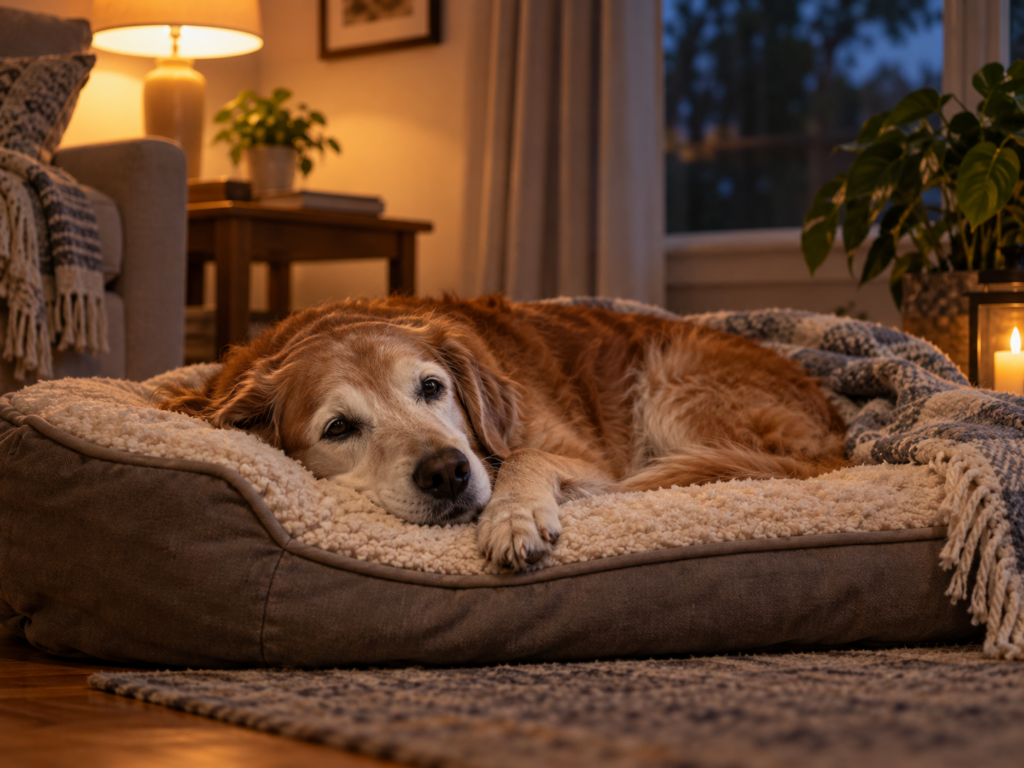
WATCH THE RESPONSE
The setup should make the night easier—not create a different struggle.
Notice whether your dog settles, moves safely, finds what they need, and seems comfortable in the space.
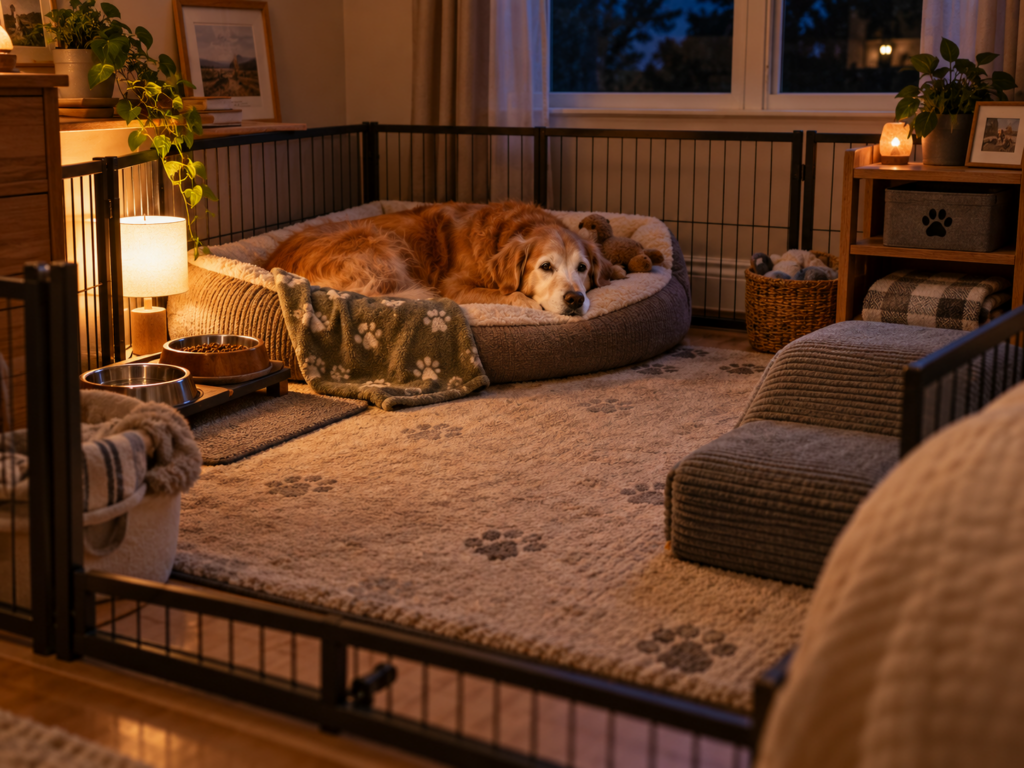
CHECK THE SETUP
What happens when your dog sleeps there?
The goal is not to find the “correct” setup for senior dogs in general.
The goal is to find the setup that helps your dog stay safer and more settled without creating a new problem.
NIGHTTIME ACCIDENTS
A bedtime potty trip does not explain every overnight accident.
It’s frustrating to find an accident after you took your dog outside right before bed. But the bedtime trip is only one part of the pattern. It does not tell you by itself why the accident happened.
Instead of assuming your dog simply “forgot” their house training, record what happened before the accident, when it occurred, and whether anything else about toileting, drinking, mobility, or nighttime behavior has changed.
LOOK AT THE PATTERN
The useful question is not just, “Did I take my dog out before bed?”
Ask what happened during that last trip, when the accident occurred, and whether the same sequence is repeating.
TRACK THE ACCIDENT
What happened before during and after?
A new accident pattern is worth paying attention to—especially if it begins suddenly, becomes more frequent, or appears alongside other changes.
You don’t have to decide whether the cause is behavioral, physical, or something else before discussing it with your veterinarian. Bring the pattern you have observed.
COMPARE THE OUTCOME
Don’t ask only, “Did it help sleep?”
Maybe you’ve already tried something—a medication recommended by your veterinarian, a different sleeping setup, a change in routine, a supplement, or another adjustment at home.
The temptation is to judge the result with one question: “Did it work?” But a change can help one part of the night while leaving another part unchanged—or create a new problem the next morning.
MORE USEFUL THAN “IT WORKED”
“The pacing improved, but the waking didn’t.”
Or:
“She slept two hours longer, but she was much more groggy the next morning.”
COMPARE EACH PART
What actually changed?
A partial response is still useful information.
So is no response. So is improvement in one area alongside a new problem somewhere else.
MAKE THE PATTERN VISIBLE
You do not need a perfect sleep diary.
You don’t need to record every movement your dog makes all night. The goal is simply to collect enough information to see whether the pattern is changing.
For the next seven nights, try to notice the same few things each time. Consistency matters more than perfect notes.
THE GOAL IS NOT PERFECT DATA
You are looking for a pattern you can compare.
Seven imperfect nights of notes can be more useful than trying to remember whether “this week seemed better.”
Use it on screen or print it. Track what you notice, compare nights, and bring the pattern to your next veterinary conversation.
FOR EACH NIGHT
What should you record?
Missed something? Keep going.
An incomplete entry does not ruin the tracker. Record what you can and look for the pattern across several nights.
WHEN TO GET HELP
Not every nighttime change should be treated as a sleep problem.
Senior dogs can wake at night for many different reasons, and the behavior you see at home does not tell you by itself what is causing it.
If a nighttime change is new, sudden, rapidly worsening, or accompanied by other concerning changes, contact your veterinarian rather than assuming it is simply part of getting older.
YOU DO NOT NEED THE DIAGNOSIS FIRST
Bring the pattern you have observed.
When it started, how often it happens, what your dog does, and what else has changed are all useful information to share.
CONTACT YOUR VETERINARIAN WHEN
The nighttime change comes with something more.
If your dog is having difficulty breathing, collapses, cannot stand, appears to be in severe pain or distress, or you believe something is immediately wrong, seek veterinary care promptly.
BRING BETTER INFORMATION
Replace “He isn’t sleeping” with a pattern you can describe.
You don’t need to arrive at the veterinary appointment knowing why the nighttime problem is happening.
What helps is being able to describe when the change started, how often it happens, what your dog does during the waking, and whether anything else has changed at the same time.
INSTEAD OF
“He’s up all night.”
TRY
“He usually settles around 10:30, sleeps for about two hours, then wakes three or four times. Most wakings include about 10 to 20 minutes of pacing before he lies back down. He usually doesn’t ask to go outside. This started about three weeks ago and seems to be getting more frequent.”
That description gives your veterinarian a timeline, frequency, behavior pattern, and a sense of how the problem is changing.
BEFORE THE APPOINTMENT
Bring what you can.
Questions you may want to ask
The goal is not to direct the diagnosis.
The goal is to make it easier for your veterinarian to understand what life at home actually looks like.
GO DEEPER
What part of the night do you need help with next?
Once you can describe the pattern, the next step is to focus on the part of the night that is causing the most trouble.
REPEATED WAKING
My dog wakes every few hours.
Focus on when the waking happens, how many times it occurs, what your dog does afterward, and how long it takes to settle again.
Why Does My Senior Dog Wake Every Two Hours? →
PACING & WANDERING
My dog paces at night.
Track when the pacing starts, how long it lasts, what happens immediately before it, and whether anything consistently helps your dog settle.
Senior Dog Pacing at Night →
TREATMENT & TRACKING
I can’t tell if what we tried is helping.
Compare settling, waking, pacing, accidents, total sleep, and next-day alertness separately instead of reducing everything to “worked” or “didn’t work.”
NIGHT SETUP
The sleeping setup isn’t working anymore.
Look at whether confinement, free-roam, flooring, access to water, lighting, and proximity to you are making the night easier—or adding a new problem.
Not sure which path fits? Start with the change that is happening most consistently and work from there.
TRACK THE NIGHT
A clearer night starts with a clearer pattern.
You don’t have to remember every detail. Track what happens for seven nights—when your dog settles, when they wake, what happens during the waking, and how they seem the next morning.
Bring that pattern to your next veterinary conversation.
Notice. Track. Compare. Ask.