
SENIOR DOG CHANGES, MADE CLEARER
Your senior dog is acting differently. Start with what changed.
Practical, evidence-informed help for confusing changes in sleep, behavior, memory and daily life—so you can track what matters and have better conversations with your veterinarian.
No miracle claims. No diagnosing your dog online. Just clearer observations, better questions and practical next steps.
THE WHAT CHANGED? METHOD
One change can affect several outcomes.

Night pacing
Better
Number of wake-ups
Same
Morning alertness
Worse
Accidents
Can’t Tell
CHOOSE YOUR STARTING POINT
What problem are you trying to solve?
Most senior-dog advice starts with a diagnosis. Real life usually starts with a behavior that suddenly doesn’t make sense.
01 · NIGHTS & SLEEP
He’s pacing, waking, panting or roaming at night.
Learn what to observe, what can mimic sundowning, and how to tell whether a nighttime setup is helping or adding distress.
02 · TREATMENT & TRACKING
You tried something—but you can’t tell if it worked.
Separate sleep, pacing, distress, accidents, engagement and next-day grogginess instead of reducing everything to “better” or “worse.”
03 · HOME CARE
Accidents, getting stuck, slipping or wandering are taking over the house.
Match practical home changes and products to the specific problem they are meant to solve.
OUR SIGNATURE FRAMEWORK
Notice → Track → Compare → Ask
The goal isn’t to turn you into your dog’s veterinarian. It’s to help you become a better observer of the changes your veterinarian needs to understand.
01 NOTICE
What changed from your dog’s normal pattern?
02 TRACK
When, how often, how long and what happened around it?
03 COMPARE
Better, same, worse—or still too unclear to judge?
04 ASK
Bring the pattern—not just the feeling—to your veterinarian.
FREE PRACTICAL RESOURCES
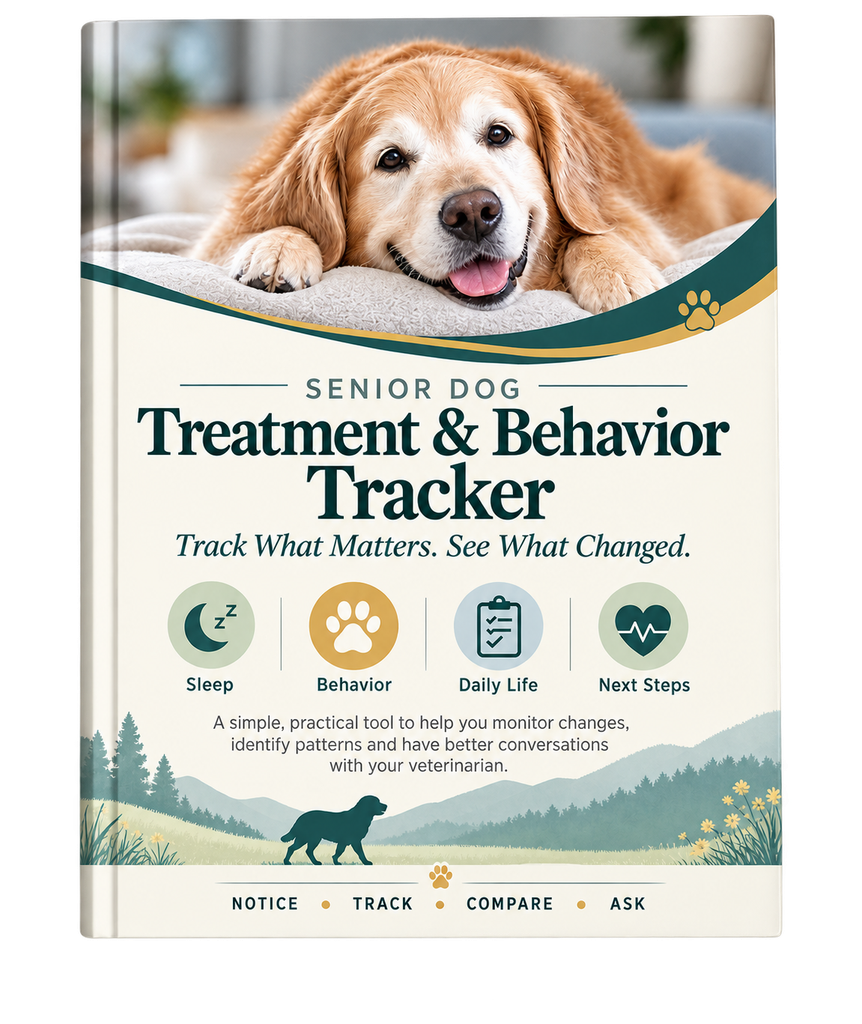
The Senior Dog Treatment & Behavior Tracker
A 7-day printable and fillable tracker designed to answer one deceptively difficult question: what actually changed?
WHY IT EXISTS
“It worked” is usually too vague.
A change may reduce pacing without improving sleep—or help at night while making your dog much groggier the next day. The tracker helps you separate those outcomes instead of reducing everything to “worked” or “didn’t work.”
START WITH THE REAL QUESTIONS
Questions senior-dog owners actually need answered
Start with the question that sounds most like what you’re seeing right now.
How do I know if the treatment is actually helping?
Separate the target outcome from sedation, coincidence and partial improvement.
Why is my senior dog waking every two hours?
Track the pattern before assuming every waking has the same cause.
Should my dog sleep in a crate, pen, small room or free-roam?
Look for signs that the setup reduces—or increases—distress.
Why are accidents still happening after a bedtime potty trip?
Management and medical rule-outs matter more than blaming “forgetfulness.”
Is this dementia—or something else?
New behavior changes can have several possible explanations.
What if my dog’s body still works but their mind is changing?
Track function, comfort and meaningful engagement over time.
SENIOR DOG SIGNALS
Clearer observations make better conversations possible.
When “something’s different” becomes a pattern you can describe, your next veterinary conversation can become much more specific.