
HOME CARE
Make everyday life at home safer without taking away your dog’s independence.
Accidents, slipping, getting stuck, wandering, or hesitating in familiar spaces can change how your senior dog uses the house. These changes don’t always point to one clear cause, but they can show you where daily life has become harder.
Start by noticing where the difficulty happens, what your dog was trying to do, and whether the same pattern appears again. Then make one practical change at a time so you can tell what actually helps.
FIND THE TROUBLE SPOT
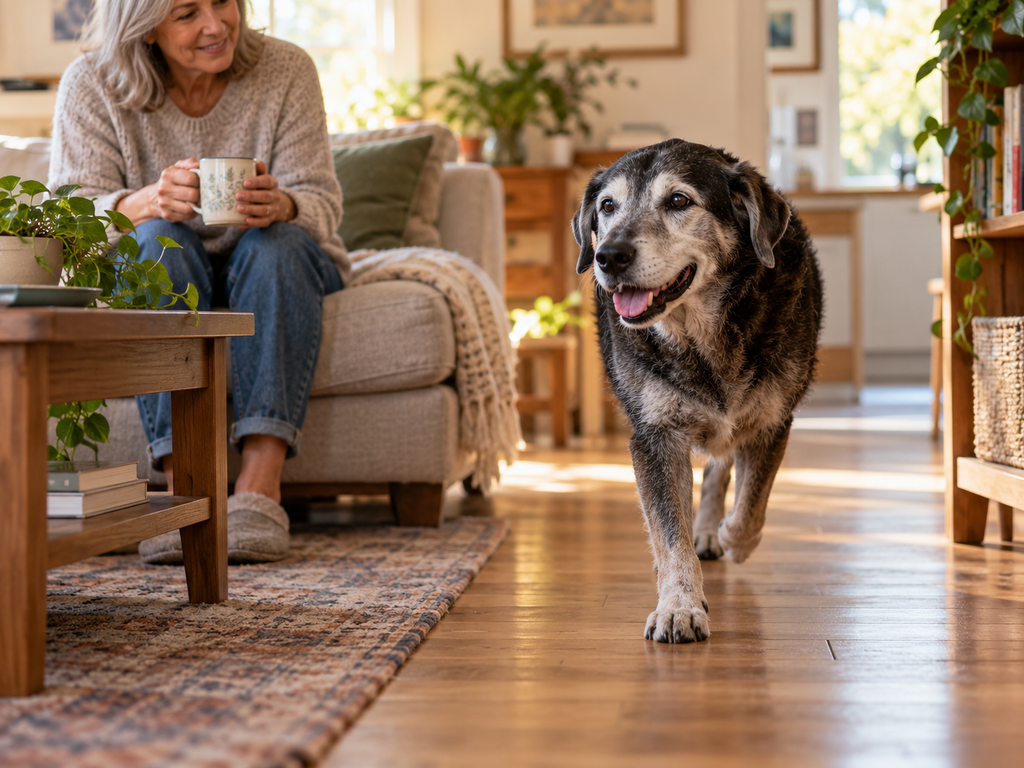
Walk the route your dog actually uses.
Instead of looking at the whole house at once, follow the route your dog uses every day—from the bed to the water bowl, from the living room to the door, or from a favorite resting spot to the place they usually eat.
Watch for the exact point where movement becomes slower, less confident, or more complicated. Your dog may move comfortably through most of the route but hesitate at one slick floor, tight turn, threshold, or step.
That trouble spot gives you somewhere specific to start. Instead of changing everything at once, you can make one adjustment and see whether the route becomes easier.
WALK THE ROUTE
Where does the pattern change?
You’re looking for the point where an ordinary route stops being ordinary. That is often the most useful place to begin making the home easier to navigate.
SLIPPING & FOOTING
Traction works best as a path—not a patch.
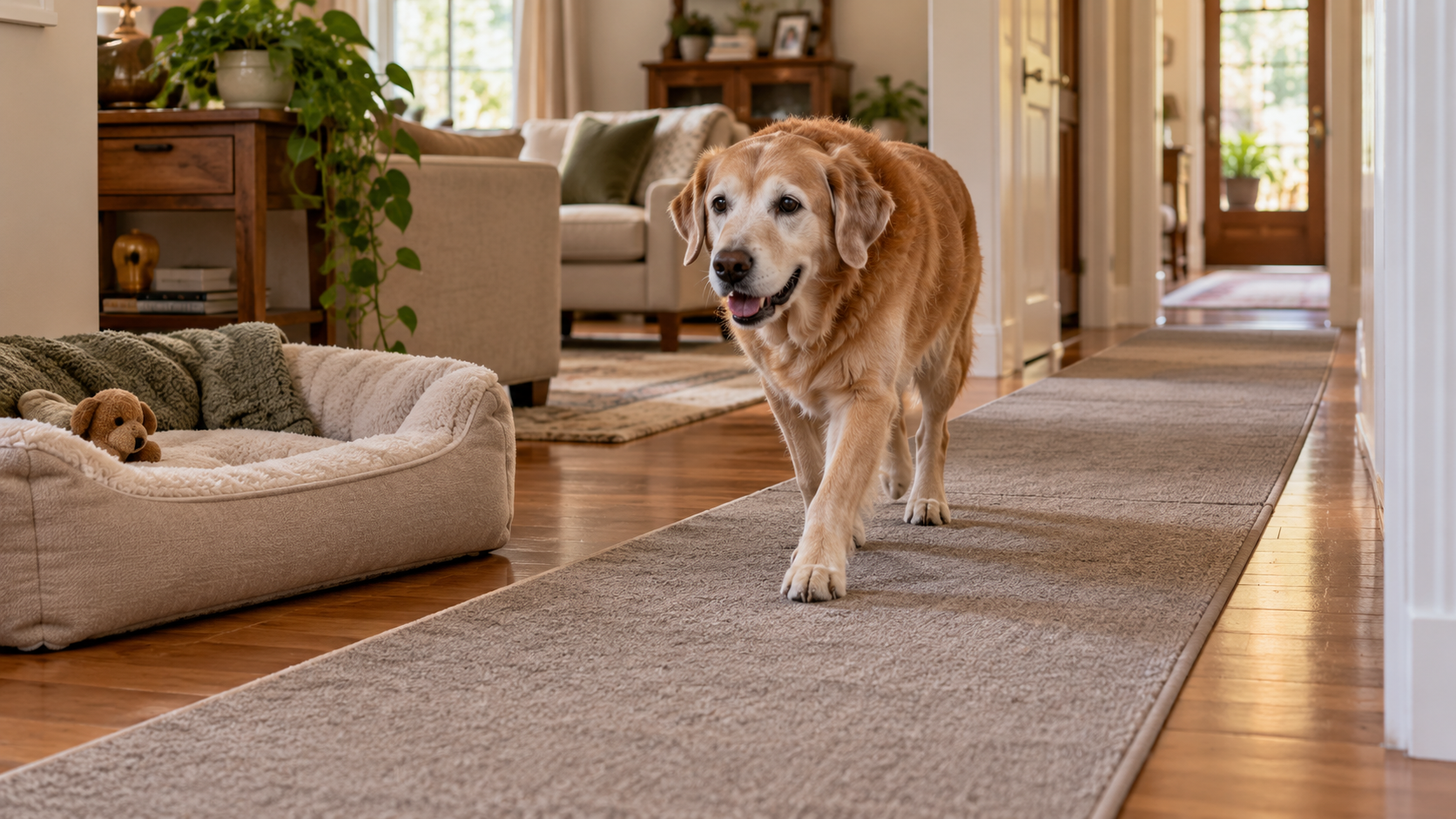
A single nonslip mat may help at one difficult spot, but your dog still has to get to it. If the route between the bed, water bowl, living area, and outside includes stretches of slick flooring, those gaps can become the hardest part.
Think in terms of a continuous route. Start where your dog needs the most traction, then connect the places they use most often.
START WHERE IT MATTERS MOST
Start where your dog pushes or turns.
Prioritize the places where your dog has to stand up, lower down, turn, or pause. Those movements often demand more traction than simply walking straight ahead.
Look first around beds, food and water bowls, favorite resting spots, and the doors your dog uses to go outside.
CONNECT THE ROUTE
Connect the important destinations.
Create a continuous nonslip path between the places your dog uses most: resting areas, water, the main living space, and the route outside.
A series of secure runners or mats can be more useful than one isolated patch if bare flooring still separates the places your dog needs to reach.
CHECK THE TRANSITIONS
Check every transition.
Pay special attention to where one surface changes into another—rug to bare floor, room to hallway, floor to threshold, or level ground to a step or ramp.
Make sure mats lie flat, don’t slide or bunch, and do not create a raised edge that becomes another obstacle. The goal is easier footing without adding a new place to trip or hesitate.
LOOK AT THE WHOLE ROUTE
A secure island in the middle of a slippery route may not solve the problem.
Walk the path from beginning to end and look for every place your dog still has to cross an unstable surface.
GETTING STUCK & NAVIGATION
When a familiar space suddenly becomes harder to navigate.
A senior dog may still move around the house but begin having trouble with particular spaces—getting behind furniture and not backing out, pausing at a doorway, entering a corner, or seeming unsure how to continue along a familiar route.
Instead of focusing only on the moment your dog gets stuck, look at the shape of the space around them. Tight turns, dead ends, narrow gaps, clutter, furniture placement, and changes in lighting can all affect how easy a route is to use.
The goal is not to decide why your dog is having trouble. It is to notice where the trouble happens repeatedly and make that part of the home easier to move through.
WATCH WHERE IT HAPPENS
One awkward moment may be random. A repeated trouble spot is a pattern.
If your dog repeatedly hesitates, turns the wrong way, or gets trapped in the same kind of space, record where it happens and what the surroundings have in common.
CHECK THE SPACE
Where does your dog seem to lose the route?
Make the route easier to read.
Where possible, open tight pathways, block access to spaces where your dog repeatedly becomes trapped, keep familiar routes clear, and avoid unnecessary changes to furniture placement.
Change one thing at a time when you can, so you can see whether the adjustment actually makes the route easier.
ACCIDENTS & GETTING OUTSIDE
When the usual potty routine stops working, look at the whole route to the door.
A new accident can be easy to interpret as a house-training problem. But for a senior dog, it is worth looking at everything that has to happen between noticing the need to go and actually reaching the appropriate place.
Your dog may need to get up, cross the room, reach the door, wait for help, manage a threshold or step, and then make it across the outdoor surface. If one part of that sequence has become harder, the whole routine may start to break down.
Instead of asking only where the accident happened, follow the routine from the beginning and look for the first point where your dog slows down, hesitates, or needs more help than before.
FOLLOW THE WHOLE SEQUENCE
The accident may be the last step in a longer problem.
Watch what happens from the moment your dog gets up until they reach—or fail to reach—the place they normally use.
New accidents can also have medical causes. If they begin suddenly, become more frequent, or occur with changes in thirst, urination, bowel habits, pain, mobility, or behavior, discuss the pattern with your veterinarian rather than assuming it is simply part of aging.
AFTER AN ACCIDENT
Notice what happened next.
Did your dog seem aware of what happened? Did they continue toward the door, return to bed, seem distressed, or simply carry on? You do not need to interpret the behavior—just record what you saw.
FOLLOW THE ROUTE
Where does the routine start to break down?
1
Getting Up
Can your dog stand up from the bed or resting spot without struggling? Watch for repeated attempts, slipping, hesitation, or needing help.
2
Crossing the Room
Can your dog move across the floor confidently? Look for slick surfaces, tight turns, clutter, or hesitation along the route.
3
Reaching the Door
Can your dog get to the door before the urgency becomes too much? Notice whether the route has become slower or more complicated.
4
Waiting for Help
Can your dog signal the need to go out and wait comfortably? A dog who once waited easily may now need a faster response.
5
Crossing the Threshold
Can your dog manage the doorway, step, porch, or ramp? The transition itself may have become the hardest part.
6
Reaching the Toileting Area
Can your dog comfortably reach and use the usual outdoor spot? Consider traction, distance, lighting, weather, and whether the surface has become harder to manage.
Look for the step that is no longer automatic.
A shorter route, better traction, easier door access, improved lighting, or fewer obstacles may make the routine easier to complete. Change one thing at a time when possible so you can see what actually helps.
RESTING & GETTING COMFORTABLE
A comfortable bed only helps if your dog can use it easily.
A senior dog may still want to rest in a familiar place but have more difficulty getting onto the bed, turning around, lowering down, changing position, or standing back up.
Watch the whole sequence instead of judging the bed only by how soft or supportive it feels. A resting place can be comfortable once your dog is lying down but still be difficult to enter or leave.
The goal is to make rest easier without taking away more independence than necessary. Look for the point where your dog starts needing extra effort, hesitation, or help.
WATCH THE WHOLE MOVEMENT
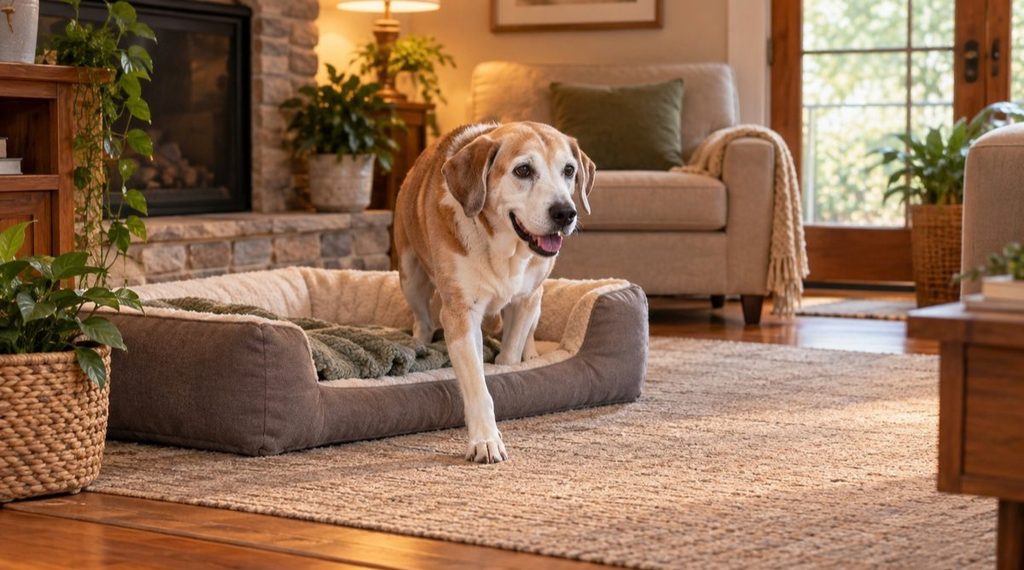
Getting comfortable includes getting back up.
Notice the approach, step onto the bed, turn, lie down, reposition, stand up, and step away. Trouble at any one of those points can change whether the resting area is actually working.
If lying down, standing up, or changing position appears painful or becomes noticeably harder, that change is worth discussing with your veterinarian rather than treating it only as a bedding problem.
CHECK THE RESTING AREA
Can your dog get comfortable without struggling?
The easiest bed to rest on may not be the easiest bed to get into or out of.
Look at height, stability, surrounding traction, and how much room your dog has to turn and reposition—not just softness or cushioning.
EVERYDAY ESSENTIALS
Make the things your dog needs easiest to reach.
Food, water, resting places, outside access, and time near you are all part of your dog’s everyday routine. As movement becomes harder, even familiar destinations can require more effort than they used to.
Look at the route to each one and remove unnecessary obstacles where you can. The goal is not to rearrange the entire house—it is to make the important destinations easier to reach.
FOOD & WATER
Make the approach as easy as the meal.
Notice whether your dog can reach the bowls, stand comfortably while eating or drinking, and move away without slipping or making a difficult turn.
RESTING AREAS
Keep a comfortable place within easy reach.
A favorite bed or resting spot is more useful when your dog can reach it without crossing a slick floor, navigating clutter, or climbing over an obstacle.
OUTSIDE ACCESS
Shorten the difficult part of the route.
Look at the path from the places your dog spends the most time to the door. Clear unnecessary obstacles, improve footing, and make the threshold or step easier to manage where possible.
TIME WITH YOU
Make connection easy too.
If your dog likes being near you, make sure there is a comfortable place they can reach without repeatedly crossing a difficult floor, climbing onto furniture, or navigating a tight space.
KEEP THE IMPORTANT PLACES EASY TO REACH
Familiar destinations work best when the route stays simple.
When possible, keep bowls, beds, outside access, and familiar resting places in locations your dog already knows. Make one practical change at a time so you can see whether the route becomes easier.
LIGHTING & NIGHTTIME MOVEMENT
Help familiar nighttime routes feel easier to follow.
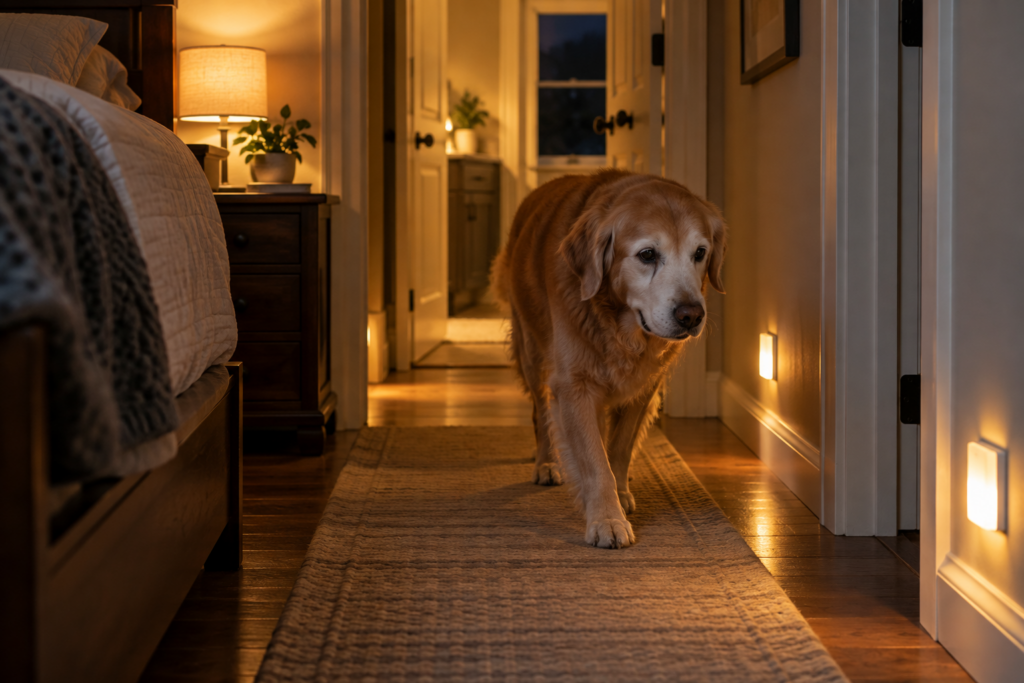
Your dog may move comfortably through the house during the day but become more hesitant after dark. Doorways, furniture edges, changes in flooring, steps, and tight turns can all be harder to navigate when there is less light.
You do not need to brighten the entire house or change everything at once. Start with the places your dog already uses at night and make those familiar routes a little easier to see and move through.
Then watch your dog rather than assuming the change helped. Less hesitation, more confident movement, or an easier time finding a familiar destination can tell you whether you are moving in the right direction.
If your dog suddenly starts bumping into things, has much more trouble finding familiar places, or shows a noticeable change in vision or navigation, let your veterinarian know. Lighting may make the home easier to use, but a new change like this deserves attention beyond the environment itself.
LIGHT THE ROUTE
Add light where your dog needs it most.
Doorways, corners, thresholds, steps, and the route to water or outside are good places to begin. Gentle, consistent lighting may be enough to make these transitions easier to recognize.
KEEP THE ROUTE FAMILIAR
Let the surroundings stay predictable.
When possible, keep the nighttime path clear and avoid moving furniture or placing new obstacles along a route your dog already knows. Familiar surroundings can make the trip from one place to another simpler.
WATCH WHAT CHANGES
Let your dog’s response guide the next adjustment.
Notice whether your dog pauses less, approaches a doorway more comfortably, finds the bed or water more directly, or still has trouble in the same place. You can adjust again if the first change does not seem to help.
START WITH THE FAMILIAR ROUTE
Make the next step easier to see.
Think about where your dog goes after dark—the path from the bed to water, the door, your room, or another familiar resting place. A little extra visibility along those routes may be more useful than adding bright light everywhere.
WHEN HOME CHANGES AREN’T ENOUGH
Sometimes making the house easier is only part of the answer.
Better footing, clearer pathways, easier access to beds, and a more predictable setup can make everyday life gentler for a senior dog. Those changes can be genuinely helpful—but they do necessarily explain why a new difficulty began.
If something is new, becoming harder, or showing up in more than one part of your dog’s day, it may be time to bring the pattern to your veterinarian rather than continuing to adjust the home on your own.
WHEN SOMETHING IS NEW
A new change is worth noticing early.
If your dog suddenly begins slipping, having accidents, getting stuck, struggling to stand, or having trouble with a familiar route, make a note of when it started and let your veterinarian know.
You do not need to understand the cause before starting that conversation.
WHEN IT KEEPS GETTING HARDER
Look at how the pattern is changing.
A difficult moment once in a while is different from something that is happening more often, lasting longer, or requiring more help from you.
That direction of change matters, even when you are not yet sure what is behind it.
WHEN SEVERAL THINGS CHANGE
Step back and look at the whole day.
A little more slipping, a few accidents, less interest in food, more trouble getting comfortable, or new nighttime restlessness can be easy to think about separately.
When several changes begin appearing together, share the whole picture with your veterinarian rather than trying to solve each one as a separate household problem.
YOU DO NOT HAVE TO FIGURE IT OUT FIRST
Bring what you’ve noticed.
Where the difficulty happens, when it began, how often it occurs, what seems to make it easier or harder, and what else has changed are all useful pieces of the story.
The changes you make at home can help your dog stay more comfortable while you work through the bigger picture with your veterinarian. They do not have to provide the whole answer.
If your dog is having difficulty breathing, collapses, cannot stand, appears to be in severe pain or distress, or something seems immediately wrong, seek veterinary care promptly.
MAKE HOME EASIER
Start with one place where everyday life has become harder.
You do not have to redesign the whole house. Choose one familiar route, resting place, doorway, or daily routine that seems more difficult than it used to be.
Make one practical change, then give yourself time to notice the response. Does your dog move more comfortably? Hesitate less? Reach what they need more easily? Or does the same difficulty remain?
That response helps you decide what to keep, what to adjust, and what to bring to your veterinarian.
One change. One pattern to watch. A clearer picture of what helps.